
November 24, 2025
Paw Protecc: Supporting homeless pets through practical solutions
Paw Protecc: Supporting homeless pets through practical solutions
Aanchal Jain
Director, Corporate Affairs, Mars Petcare India
Share this story
India is home to an estimated 100 million cats and dogs, but nearly 70% of them are homeless. According to our State of Pet Homelessness Project, this includes more than 52 million dogs and 8 million cats living on the streets, and another 8 million dogs and 800,000 cats in shelters. Behind these numbers, India’s homeless dogs and cats face very real daily threats from traffic, disease, malnutrition, and increasingly, extreme weather.
In August 2025, India’s Supreme Court issued and later revised rulings on the management of stray dogs—initially calling for their relocation to shelters, then allowing vaccinated and sterilised dogs to be returned to their communities. The discussions underscored the complexity of balancing public safety, infrastructure capacity, and animal welfare.
The scale of the issue is daunting, but it’s also a crucial call to action. Our State of Pet Homelessness Project, the largest global study of its kind, highlights how pet homelessness is shaped not only by abandonment, but by broader systemic challenges, whether that’s climate change, urbanisation, or gaps in care.
One example of how local action can respond to these global challenges is Paw Protecc, a grassroots initiative launched in India in August 2024. Developed by Mars in partnership with Swiggy Instamart, Paw Protecc began as an emergency response to severe monsoon rains. Today, it has evolved into a year-round program supporting homeless pets across five major cities.
Responding to a real need
The idea for Paw Protecc was sparked by a call to action from the Animal Welfare Board of India, which encouraged companies to create temporary shelters for homeless and community pets during extreme weather. With climate-related events becoming more frequent and intense, cities like Delhi, Mumbai, and Bangalore have experienced unprecedented rainfall, leaving these animals vulnerable and exposed.
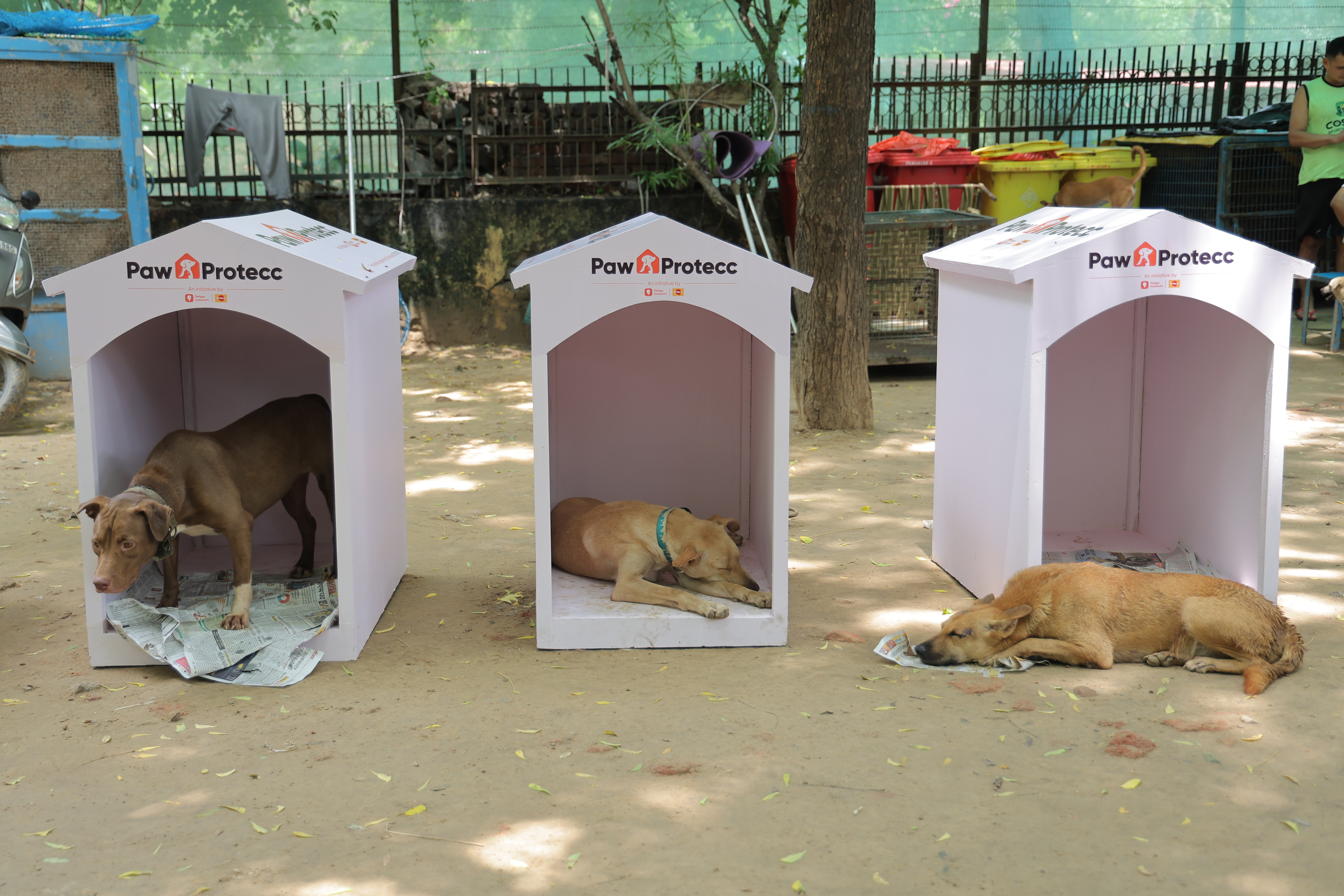
Mars responded by collaborating with local startups and infrastructure experts to develop a model for small, mobile shelters designed to withstand diverse weather conditions. Built from readily available materials - durable wood on an iron frame - the shelters are sturdy, relocatable, and suited to urban environments.
This practical solution provides a flexible and scalable model that can be adopted in other regions where climate change is reshaping the risks faced by homeless pets - from heatwaves in southern Europe to flooding in Southeast Asia.
Scaling through partnership
To expand the initiative, Mars partnered with Swiggy Instamart, India’s leading e-commerce platform. The partnership initially saw 150 shelters rolled out across five major cities: Delhi, Mumbai, Bangalore, Chennai, and Hyderabad.
Collaboration was key to the program’s success. Local animal feeders, NGOs, and civic bodies played a fundamental role in identifying shelter locations, securing permissions, monitoring usage, and sharing feedback. Mobile shelters were placed near established feeding points and paired with nutritious meals and clean water to support the overall wellbeing of homeless pets.
Social media also amplified the initiative, with community members sharing photos, videos, and testimonials. This engagement helped to build awareness and encouraged further participation.
While the partnership between Mars and Swiggy helped to scale the initiative, it’s clear that local ownership and trust are essential to sustaining long-term impact. When communities are involved from the outset, the result can be instrumental, building a shared sense of responsibility – a vital ingredient for helping initiatives like this endure beyond their initial rollout.
Evolving to meet year-round needs
What began as a seasonal intervention has evolved into a permanent support system. Paw Protecc has expanded to provide year-round care, adapting to changing needs and growing demand.
The initiative now includes over 1,000 shelters across multiple cities. Its impact hasn’t gone unnoticed. In 2024, Paw Protecc was recognised as one of the most effective community-driven animal welfare initiatives in India, receiving multiple accolades, including the Sabre South Asia Award.
The evolution from emergency response to long-term infrastructure also highlights a broader shift in how we must address pet homelessness globally - moving from reactive to proactive and from short-term fixes to sustainable systems.
A shared responsibility
Paw Protecc shows how locally led initiatives can contribute to global change. Our State of Pet Homelessness Project underscores the need for collaborative, context-specific solutions - and Paw Protecc demonstrates that when communities, companies, and governments work together, we can make a tangible improvement to the lives of homeless and community pets.
From shelter and veterinary care to education and policy, every intervention matters and moves us closer to a future where every pet has a safe place to call home.
November 24, 2025
Paw Protecc: Supporting homeless pets through practical solutions
Aanchal Jain
Director, Corporate Affairs, Mars Petcare India
Share this story
India is home to an estimated 100 million cats and dogs, but nearly 70% of them are homeless. According to our State of Pet Homelessness Project, this includes more than 52 million dogs and 8 million cats living on the streets, and another 8 million dogs and 800,000 cats in shelters. Behind these numbers, India’s homeless dogs and cats face very real daily threats from traffic, disease, malnutrition, and increasingly, extreme weather.
In August 2025, India’s Supreme Court issued and later revised rulings on the management of stray dogs—initially calling for their relocation to shelters, then allowing vaccinated and sterilised dogs to be returned to their communities. The discussions underscored the complexity of balancing public safety, infrastructure capacity, and animal welfare.
The scale of the issue is daunting, but it’s also a crucial call to action. Our State of Pet Homelessness Project, the largest global study of its kind, highlights how pet homelessness is shaped not only by abandonment, but by broader systemic challenges, whether that’s climate change, urbanisation, or gaps in care.
One example of how local action can respond to these global challenges is Paw Protecc, a grassroots initiative launched in India in August 2024. Developed by Mars in partnership with Swiggy Instamart, Paw Protecc began as an emergency response to severe monsoon rains. Today, it has evolved into a year-round program supporting homeless pets across five major cities.
Responding to a real need
The idea for Paw Protecc was sparked by a call to action from the Animal Welfare Board of India, which encouraged companies to create temporary shelters for homeless and community pets during extreme weather. With climate-related events becoming more frequent and intense, cities like Delhi, Mumbai, and Bangalore have experienced unprecedented rainfall, leaving these animals vulnerable and exposed.
Mars responded by collaborating with local startups and infrastructure experts to develop a model for small, mobile shelters designed to withstand diverse weather conditions. Built from readily available materials - durable wood on an iron frame - the shelters are sturdy, relocatable, and suited to urban environments.
This practical solution provides a flexible and scalable model that can be adopted in other regions where climate change is reshaping the risks faced by homeless pets - from heatwaves in southern Europe to flooding in Southeast Asia.
Scaling through partnership
To expand the initiative, Mars partnered with Swiggy Instamart, India’s leading e-commerce platform. The partnership initially saw 150 shelters rolled out across five major cities: Delhi, Mumbai, Bangalore, Chennai, and Hyderabad.
Collaboration was key to the program’s success. Local animal feeders, NGOs, and civic bodies played a fundamental role in identifying shelter locations, securing permissions, monitoring usage, and sharing feedback. Mobile shelters were placed near established feeding points and paired with nutritious meals and clean water to support the overall wellbeing of homeless pets.
Social media also amplified the initiative, with community members sharing photos, videos, and testimonials. This engagement helped to build awareness and encouraged further participation.
While the partnership between Mars and Swiggy helped to scale the initiative, it’s clear that local ownership and trust are essential to sustaining long-term impact. When communities are involved from the outset, the result can be instrumental, building a shared sense of responsibility – a vital ingredient for helping initiatives like this endure beyond their initial rollout.
Evolving to meet year-round needs
What began as a seasonal intervention has evolved into a permanent support system. Paw Protecc has expanded to provide year-round care, adapting to changing needs and growing demand.
The initiative now includes over 1,000 shelters across multiple cities. Its impact hasn’t gone unnoticed. In 2024, Paw Protecc was recognised as one of the most effective community-driven animal welfare initiatives in India, receiving multiple accolades, including the Sabre South Asia Award.
The evolution from emergency response to long-term infrastructure also highlights a broader shift in how we must address pet homelessness globally - moving from reactive to proactive and from short-term fixes to sustainable systems.
A shared responsibility
Paw Protecc shows how locally led initiatives can contribute to global change. Our State of Pet Homelessness Project underscores the need for collaborative, context-specific solutions - and Paw Protecc demonstrates that when communities, companies, and governments work together, we can make a tangible improvement to the lives of homeless and community pets.
From shelter and veterinary care to education and policy, every intervention matters and moves us closer to a future where every pet has a safe place to call home.
November 24, 2025
Paw Protecc: Supporting homeless pets through practical solutions
Aanchal Jain
Director, Corporate Affairs, Mars Petcare India
Share this story
India is home to an estimated 100 million cats and dogs, but nearly 70% of them are homeless. According to our State of Pet Homelessness Project, this includes more than 52 million dogs and 8 million cats living on the streets, and another 8 million dogs and 800,000 cats in shelters. Behind these numbers, India’s homeless dogs and cats face very real daily threats from traffic, disease, malnutrition, and increasingly, extreme weather.
In August 2025, India’s Supreme Court issued and later revised rulings on the management of stray dogs—initially calling for their relocation to shelters, then allowing vaccinated and sterilised dogs to be returned to their communities. The discussions underscored the complexity of balancing public safety, infrastructure capacity, and animal welfare.
The scale of the issue is daunting, but it’s also a crucial call to action. Our State of Pet Homelessness Project, the largest global study of its kind, highlights how pet homelessness is shaped not only by abandonment, but by broader systemic challenges, whether that’s climate change, urbanisation, or gaps in care.
One example of how local action can respond to these global challenges is Paw Protecc, a grassroots initiative launched in India in August 2024. Developed by Mars in partnership with Swiggy Instamart, Paw Protecc began as an emergency response to severe monsoon rains. Today, it has evolved into a year-round program supporting homeless pets across five major cities.
Responding to a real need
The idea for Paw Protecc was sparked by a call to action from the Animal Welfare Board of India, which encouraged companies to create temporary shelters for homeless and community pets during extreme weather. With climate-related events becoming more frequent and intense, cities like Delhi, Mumbai, and Bangalore have experienced unprecedented rainfall, leaving these animals vulnerable and exposed.
Mars responded by collaborating with local startups and infrastructure experts to develop a model for small, mobile shelters designed to withstand diverse weather conditions. Built from readily available materials - durable wood on an iron frame - the shelters are sturdy, relocatable, and suited to urban environments.
This practical solution provides a flexible and scalable model that can be adopted in other regions where climate change is reshaping the risks faced by homeless pets - from heatwaves in southern Europe to flooding in Southeast Asia.
Scaling through partnership
To expand the initiative, Mars partnered with Swiggy Instamart, India’s leading e-commerce platform. The partnership initially saw 150 shelters rolled out across five major cities: Delhi, Mumbai, Bangalore, Chennai, and Hyderabad.
Collaboration was key to the program’s success. Local animal feeders, NGOs, and civic bodies played a fundamental role in identifying shelter locations, securing permissions, monitoring usage, and sharing feedback. Mobile shelters were placed near established feeding points and paired with nutritious meals and clean water to support the overall wellbeing of homeless pets.
Social media also amplified the initiative, with community members sharing photos, videos, and testimonials. This engagement helped to build awareness and encouraged further participation.
While the partnership between Mars and Swiggy helped to scale the initiative, it’s clear that local ownership and trust are essential to sustaining long-term impact. When communities are involved from the outset, the result can be instrumental, building a shared sense of responsibility – a vital ingredient for helping initiatives like this endure beyond their initial rollout.
Evolving to meet year-round needs
What began as a seasonal intervention has evolved into a permanent support system. Paw Protecc has expanded to provide year-round care, adapting to changing needs and growing demand.
The initiative now includes over 1,000 shelters across multiple cities. Its impact hasn’t gone unnoticed. In 2024, Paw Protecc was recognised as one of the most effective community-driven animal welfare initiatives in India, receiving multiple accolades, including the Sabre South Asia Award.
The evolution from emergency response to long-term infrastructure also highlights a broader shift in how we must address pet homelessness globally - moving from reactive to proactive and from short-term fixes to sustainable systems.
A shared responsibility
Paw Protecc shows how locally led initiatives can contribute to global change. Our State of Pet Homelessness Project underscores the need for collaborative, context-specific solutions - and Paw Protecc demonstrates that when communities, companies, and governments work together, we can make a tangible improvement to the lives of homeless and community pets.
From shelter and veterinary care to education and policy, every intervention matters and moves us closer to a future where every pet has a safe place to call home.
How can you help?
Donate to our partner program
Lorem ipsum dolor sit amet consectetur. Imperdiet fringilla pharetra nisl in ante ac. Ultrices nunc quam lobortis velit lectus. Penatibus tellus aliquet vulputate vulputate sed.
Help us improve the Index data
Do you work with animal related data in one of the countries in the index? We are always looking for ways to improve the Index data in every country.
How can you help?
Donate to our partner program
Lorem ipsum dolor sit amet consectetur. Imperdiet fringilla pharetra nisl in ante ac. Ultrices nunc quam lobortis velit lectus. Penatibus tellus aliquet vulputate vulputate sed.
Help us improve the Index data
Do you work with animal related data in one of the countries in the index? We are always looking for ways to improve the Index data in every country.
How can you help?
Donate to our partner program
Lorem ipsum dolor sit amet consectetur. Imperdiet fringilla pharetra nisl in ante ac. Ultrices nunc quam lobortis velit lectus. Penatibus tellus aliquet vulputate vulputate sed.
Help us improve the Index data
Do you work with animal related data in one of the countries in the index? We are always looking for ways to improve the Index data in every country.